
This paper is the collective work of Louis Liebenberg, Nxjouklau Kashe, ǀUase Xhukwe, ǀUi Gǀaq’o, ǀUi ǀKunta, ≠Oma Daqm, Dam Debe, Jan Kirrie, Omakai Kruiper and Klaas Kruiper. Acknowledgement to the wisdom of the late !Nam!kabe Molote, !Nate Brahman, Horekhwe (Karoha) Langwane, Wilson Masia, Karel Kleinman, ǀUi ǀUkxa, Dabe Dahm and ǀKun ǀǀXari.
The objectives of the Indigenous Tracker Certification include the recognition of indigenous knowledge and the promotion of the cultural, social and economic benefits of the art of tracking. The employment of trackers also helps to retain indigenous skills that may otherwise be lost soon.
In a traditional hunter-gatherer context, the success (or failure) of hunts acted as a test of trackers’ skills. As hunter-gatherer communities transition to a mixed cash economy and spend less time hunting, their tracking skills are being lost. To compensate for this culture change, tracker certification and potential employment opportunities provide not only an objective test of their skills, but also an incentive to revitalize and sustain their tracking skills into the future. Employment opportunities that require high levels of tracking skills, equivalent to that required for traditional hunting, include scientific research and wildlife monitoring in biodiversity conservation.
It is recommended that a community first start with the Learning to Track Training Participant guidelines until they are familiar with the tracker evaluation process. Once they are familiar with the evaluation process they may choose to adopt the Community Indigenous Tracker Certification. Some communities, when they have reached the required standards, may adopt the CyberTracker Indigenous Tracker Certification.
The Community Indigenous Tracker Certification provide guidelines that will empower indigenous communities to develop their own tracker certification system. A community of trackers may choose to maintain their own independent tracker certification.
Some communities may choose to adopt the CyberTracker Indigenous Tracker Certification standards currently adopted by indigenous Kalahari San trackers to develop a consistent international standard for indigenous trackers.
The objective of the Community Indigenous Tracker Certification is to revitalize and stimulate the growth of practical tracking skills and expertise within a community. Following the CyberTracker Certification Process outlined in this paper will: (1) Identify the best trackers within a community and (2) Provide an effective training tool that will increase tracking skills over time. We acknowledge that since this process is applied at the local community level, standards may be inconsistent with those of other communities. The emphasis is on critical discussion, peer review within the community and scientific reasoning.
The objective of the CyberTracker Indigenous Tracker Certification is to maintain consistent certification standards across different communities. The emphasis is on critical discussion, peer review, scientific reasoning and regular External CyberTracker Evaluations to maintain standards. These are the evaluation standards that have been and continue to be practiced wherever CyberTracker is active in different parts of the world.
The Community Indigenous Tracker Certification empowers Indigenous trackers to issue their own tracker certificates. The CyberTracker Indigenous Tracker Certification maintains the standards defined by the CyberTracker Certification Standards Committee and is described in a separate document.
While the Kalahari San adopted and participated in the development of the CyberTracker peer review system of maintaining standards, some indigenous communities may choose to initiate their own tracker training and certification system. Furthermore, there are currently not enough CyberTracker External Evaluators to facilitate tracker certification in all indigenous communities worldwide. We therefore need to introduce guidelines that can be adopted by all indigenous communities, regardless of whether they chose to become part of the CyberTracker network.
The objective of the Indigenous Tracker Certification is to empower Indigenous communities to develop their own tracker certification system. A community of trackers may choose to maintain their own Community Indigenous Tracker certification independent of the established CyberTracker certification. Or they may at some point choose to adopt the CyberTracker Indigenous Tracker Certification standards. Or a community may choose to maintain their own tribal tracker certification, while some individual trackers within the tribe may obtain a CyberTracker Indigenous Tracker certificate or even a standard CyberTracker Tracker Certificate (the official CyberTracker Standards applied worldwide). This may help to introduce a cross-fertilisation of tracker expertise that may enrich the broader tracker community.
The Community Indigenous Tracker Certificates is essentially a training tool and a method to identify the best trackers within a community, following the CyberTracker Evaluation Process. Since some communities may initiate their own tracker certification, it may not follow standards that are consistent with those of other communities.
The Community Indigenous Tracker Certificates will be used: (1) To introduce tracker certification into indigenous communities where there is no formal tracker certification available to maintain or set up consistent standards. It is recommended that they start with the Learning to Track process until they are familiar with the Evaluation process. (2) As an assessment tool to identify the best trackers within a community. The best trackers can then choose to participate in the standardized CyberTracker Certification where available. (3) As a training tool to increase tracking skills over time.
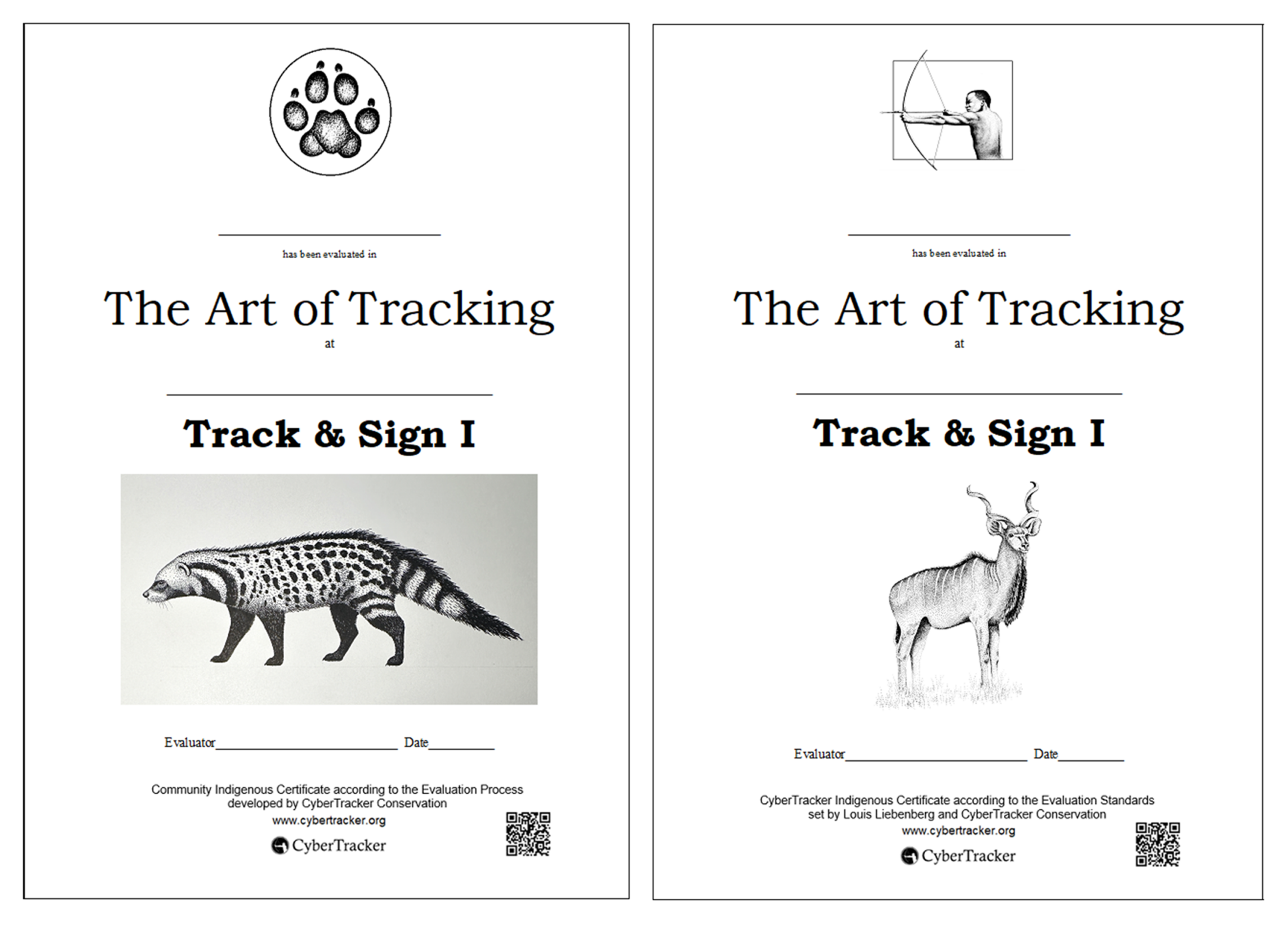
Communities may choose their own tribal logos to distinguish their own indigenous tracker certificates.
Community certificates may not use the CyberTracker logos, or use the CyberTracker brand name (apart from the small CyberTracker name and logo in the Footer at the bottom of the certificate), without permission, since it is protected by trademarks. This is to protect the standards of the CyberTracker Indigenous Tracker Certification.
Indigenous communities are welcome to join the worldwide CyberTracker tracker network.


Privacy Policy | © CyberTracker Conservation 2021. Unless otherwise stated, all text and images
on this site are copyright.
Website built by AlexM
